
Published at Journal of Solar Energy Engineering – Heliostat Consortium: Gap Analysis on State of the Art in Wind Load Design

Abstract: Wind loads are a major driver of heliostat cost. Standardized methods and tools are needed for a more detailed understanding of the static and dynamic loads of a heliostat design. This will enable cost reduction of wind-dependent heliostats to avoid unnecessarily conservative heliostat designs and increase field efficiency and reliability to reduce the risk …

Lowest cost of heat for modular sodium CSP? A “Billboard” solar receiver with a “Cartesian” heliostat layout

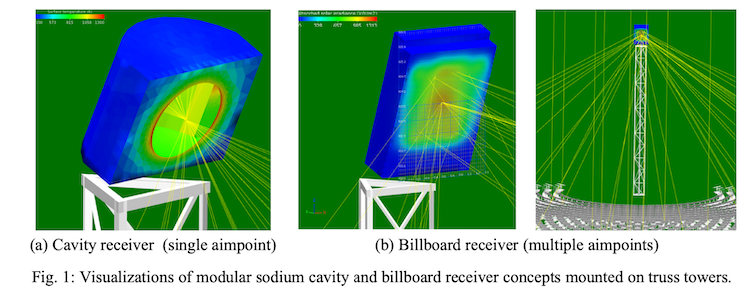
High-temperature liquid sodium receivers able to run at over 700°C may allow use of modular multi-tower system configurations similar to that being developed by the Australian firm Vast Solar (now Vast) for next-generation sodium-based concentrating solar power (CSP). Unlike today’s one tall central tower encircled by one large heliostat field, a liquid sodium-based CSP system …

Aussi petcare firm taps both solar technologies for industrial heat

  Mars Petcare will use this kind of parabolic trough concentrated solar thermal (CST) collectors for direct solar industrial heat and a thermal energy storage system also heated by electricity from Victoria’s solar-rich grid Mars petcare factory to tap sunlight for CST heat plus leverage Victoria’s world-leading renewable grid to electrically heat thermal energy storage. …

Published at Solar Compass – A critical perspective and analysis of two-step thermochemical fuel production cycles

Abstract: Two-step thermochemical fuel production cycles powered using concentrating solar systems offer a route to convert solar energy to chemical fuels. In this work, we offer a critical assessment of the state of the art, a detailed technical analysis of this technology in terms of theoretical limitations and potential performance, and potential paths forward in …

Published at Applied Thermal Engineering – Investigations of inlet arrangement strategies and particle parameters on thermochemical performance in falling particle solar reactors

Abstract: The reformation of methane to hydrogen and steam in a falling particle solar reactor (FPSR) is a promising method to use the solar energy, which converts solar energy into chemical energy. FPSR has higher operation temperature, higher pressure bearing capacity and more direct heat energy storage than those of traditional reactor. However, due to …

Published at Applied Thermal Engineering – Proposal of a novel solar-driven thermochemical reactor for green hydrogen production using helical flow channels

Abstract: The reactor is the core component of the hydrogen production system. Although hydrogen production using solar energy as the heat source can effectively reduce carbon emissions, the reactor faces the problem of uneven heating caused by the collector, and the uneven temperature distribution will significantly affect the hydrogen production process. A key characteristic of …

Dr. Aldo Steinfeld and Dr. Manuel Romero win the 2024 SolarPACES Lifetime Achievement Award

Manuel Romero and Aldo Steinfeld receive the SolarPACES Lifetime Achievement Award from Robert Pitz-Paal On the closing day of the SolarPACES 2024 conference in Rome, Aldo Steinfeld and Manuel Romero were jointly awarded the Lifetime Achievement Award, in recognition of their over 20 years collaboration in pioneering and developing the use of concentrated solar thermal …

Hot solar hydrogen reactors on a conveyor belt get a fast study

Heat from solar for a hydrogen production system working like a conveyor belt MIT’s Heat-based solar hydrogen from a train of solar reactors boasts 70% heat recovery and heat-to-hydrogen from 10% to 40% In solar reactors that use solar-heated thermo-chemistry to produce hydrogen from water, heat recovery is needed to increase efficiency and, thus, lower …

El Gobierno aprueba el PNIEC antes de la marcha de Teresa Ribera a Bruselas

El Consejo de Ministros ha aprobado este martes el Plan Nacional Integrado de Energía y Clima (PNIEC), lo que reafirma el compromiso de España con el hidrógeno verde y las energías limpias para el proceso de descarbonización. El plan fija un objetivo de 12 gigavatios (GW) de electrolizadores para producir hidrógeno verde, y mantiene la …

Published at Environmental Science and Technology – Solar-Powered Direct Air Capture: Techno-Economic and Environmental Assessment

Abstract Direct air capture (DAC) of CO2 has gained attention as a sustainable carbon source. One of the most promising technologies currently available is liquid solvent DAC (L-DAC), but the significant fraction of fossil CO2 in the output stream hinders its utilization in carbon-neutral fuels and chemicals. Fossil CO2 is generated and captured during the …